Newbery St.
DOI PANGKHON LACTIC NATURAL
DOI PANGKHON LACTIC NATURAL
Couldn't load pickup availability
For more than nine years, Beanspire Coffee has been working alongside farmers in Doi Pangkhon, Chiang Rai, a mountain community home to around 300 households growing coffee at elevations between 1,250 and 1,450 meters.
The relationship began by working directly with individual farming families, supporting their wet processing and purchasing parchment for further processing. In the 2017–2018 harvest, Beanspire took another step forward by investing in a wet mill operated by the Merlaeku family, five brothers from the Akha community.
Having a mill within the community changed what was possible. Instead of beginning with parchment, Beanspire could work with coffee from the cherry stage, giving the team greater control over processing and allowing them to begin sourcing cherries from farmers beyond the Merlaeku family.
Over the following years, the mill continued to grow. New pulpers, covered drying areas, improved workflows, an electricity generator, a farmer cupping lab, and additional drying space were added. Each investment was made with the same goal: to give farmers better tools to process their coffee and create more consistent, expressive coffees.
The 2021–2022 harvest brought a 20% increase in production, supported by expanded drying space that helped protect the coffee during Thailand’s heavy rains. The following seasons brought a different kind of challenge. Climate change has made harvests increasingly unpredictable, while changes in coffee prices and the movement of coffee across borders have created new pressures for Thai farmers.
For us, this coffee is a reflection of that journey. It is not only about what happens in the cup, but about the years of work, experimentation, and investment behind it.
The Process
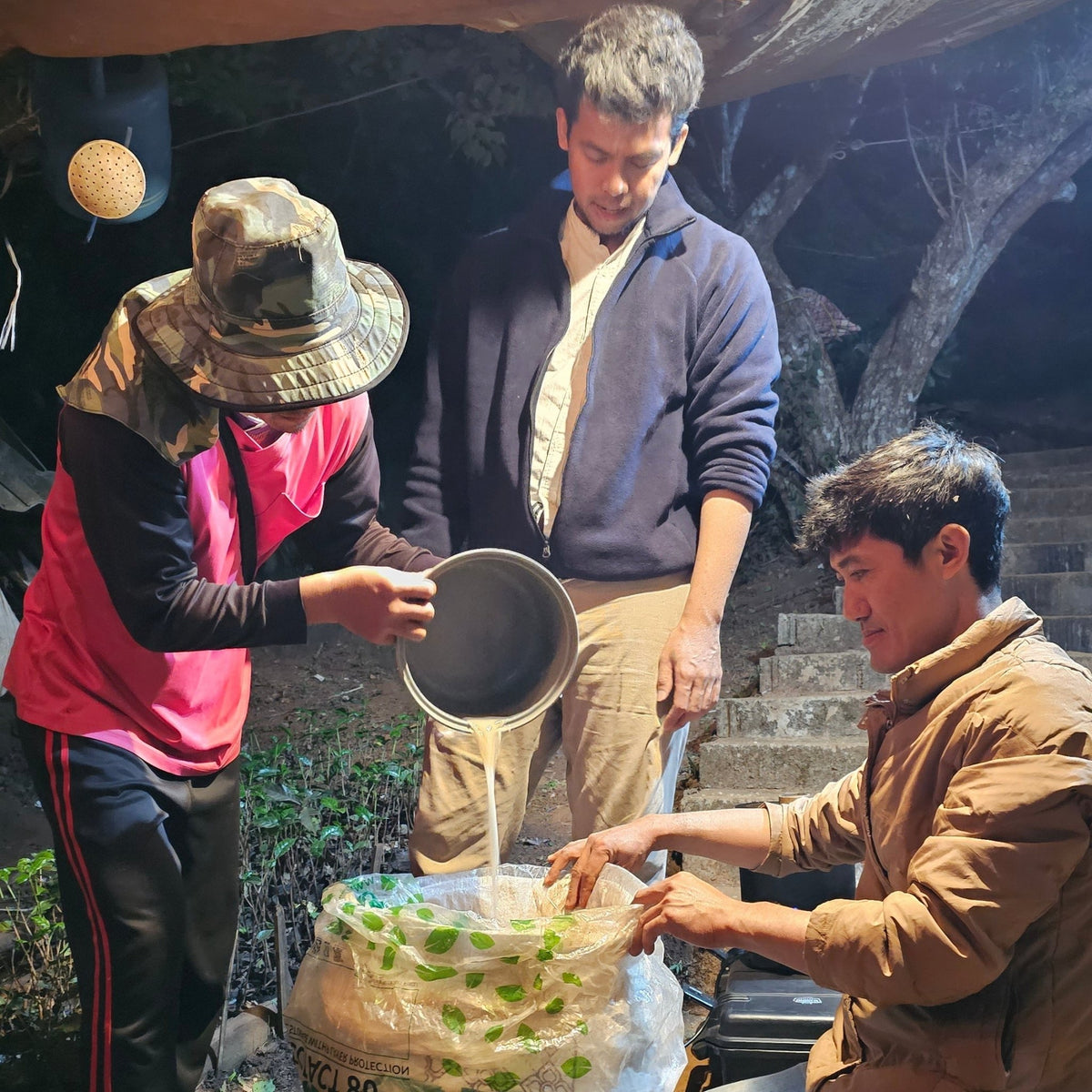
For this lot, Beanspire experimented with a fermentation process using live Lactic Acid Bacteria (Lactobacillus).
The idea was simple: introduce a living culture into the fermentation and give it time to shape the character of the coffee.
Yogurt was used to multiply the LAB culture, with approximately 10 grams of yogurt culture added for every kilogram of coffee cherries. The cherries then fermented for five days in a lightly covered tank, kept in a cool, shaded area.
Throughout fermentation, the tank was periodically mixed and rolled to encourage even contact between the cherries and the culture. This process allows the LAB to interact with the sugars in the coffee, producing lactic acid and contributing to the coffee's creamy texture, silky mouthfeel, and gentle acidity.
It is a beautiful example of how traditional coffee processing can meet experimentation. The result is a coffee that feels soft and expressive, while still carrying the character of Doi Pangkhon.
Doi Pangkhon
Doi Pangkhon sits around 19 degrees north of the equator, with farms reaching 1,250–1,450 meters above sea level. At this elevation, the cool mountain environment creates a unique place for coffee to grow in northern Thailand.
The region is home to several varieties, including Chiang Mai, a local hybrid of SL28, Caturra, and Híbrido de Timor, along with Typica and SJ133, a variety genetically identical to Costa Rica 95.
For us, Doi Pangkhon represents something we love about Thai coffee: a place where tradition, experimentation, and a new generation of producers are coming together to create something distinctly their own.
Origin : Doi Pangkhon, Chiang Rai, Thailand
Producer/Farm : Merlaeku Family x Beanspire
Process : Lactic Acid Bacteria Natural (Lactobacillus)
Roast Profile : Light
Varieties : Chiang Mai, Typica and SJ133
Altitude : 1,250–1,450 m.a.s.l.
Tasting Notes : To be cupped
Size : 8oz. (227g)
Coffee beans roasted by Newbery Street Coffee Roasters in Greater Boston
------------------------------------------------
Coffee: 16g
Grind Size: Medium
Brewer: OREA V3 MKII with Kalita Wave 185
Water: 92'C (Boston tap water with ZEROWATER: TDS 000)
Ending Time: ~1:50
| Time (s) |
|
|
| 0:00 | 50 | 50 Circle Pour |
| 0:30 | 60 | 110 Center Pour |
| 0:50 | 70 | 180 Center Pour |
| 1:20 | 60 | 240 Center Pour |
------------------------------------------------